
An AGV electric tug is a battery-powered autonomous vehicle designed to tow carts, trailers, and heavy loads through factories and warehouses without a human driver. The heart of every electric tug is its drive system — and choosing the wrong motor means either an underpowered tug that stalls under load or an oversized system that wastes battery, space, and budget. This guide covers everything a tug manufacturer or system integrator needs to specify a reliable AGV electric tug drive: motor type, power rating, gear ratio, braking, and battery interaction.
Key Takeaways
- BLDC motors are the standard for AGV electric tugs — 85-92% efficiency, compact size, and precise speed control via CAN bus or RS485.
- Motor sizing depends on towing capacity: 200-400W per wheel for 1-3 ton tugs, 750-1,500W per wheel for 5-15 ton tugs, 2,000-3,000W per wheel for 20-30+ ton tugs.
- Planetary gearboxes outperform worm gears in tug applications — 95% efficiency vs 60-70%, meaning more battery runtime and less heat.
- Electromagnetic brakes are mandatory — spring-applied, power-off brakes prevent runaway loads if power fails.
AGV Electric Tug Motor Quick Reference
| Tow Capacity | Motor Power (per wheel) | Voltage | Gear Ratio | Brake |
|---|---|---|---|---|
| 1–3 tons | 200–400W BLDC | 24V | 15:1–20:1 | 5 N.m |
| 3–8 tons | 400–750W BLDC | 48V | 25:1–30:1 | 20 N.m |
| 8–15 tons | 750–1,500W BLDC | 48V | 30:1–40:1 | 30 N.m |
| 15–30 tons | 1,500–3,000W BLDC | 48–72V | 40:1–50:1 | 40 N.m |
All specifications from Shenghe Zhilian production data. Request exact sizing for your project →
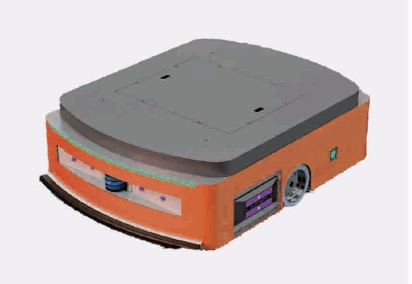
What Is an AGV Electric Tug?
An AGV electric tug — also called an automated towing vehicle, autonomous tugger, or AGV tow tractor — is a class of automated guided vehicle specifically built to pull loads rather than carry them. Unlike forklift AGVs that lift pallets, electric tugs connect to carts or trailers via a hitch and tow them along predefined routes.
This towing approach has a fundamental advantage: one tug can pull a train of multiple carts, delivering far higher throughput per vehicle than a single forklift making individual trips. In automotive assembly plants, a single AGV electric tug routinely tows a train of 4-6 carts carrying parts from the warehouse to the production line — replacing 3-4 forklift trips per cycle.
The navigation system (magnetic tape, QR code, laser SLAM, or natural navigation) handles path planning. But the drive system — motor, gearbox, controller, and brake — determines whether the tug can actually move the load reliably, efficiently, and safely. That is our focus in this guide.
AGV Electric Tug Categories by Towing Capacity
Electric tugs span a wide capacity range. The motor requirements differ dramatically between a 500 kg warehouse tugger and a 30-ton heavy transport tug. Here is how the industry segments them:
| Category | Towing Capacity | Typical Motor Power (per wheel) | Common Applications |
|---|---|---|---|
| Light-Duty Tugger | 500 kg - 2 tons | 120W - 400W | E-commerce warehouses, hospital logistics, airport baggage |
| Medium-Duty Tug | 2 - 8 tons | 400W - 1,500W | Automotive assembly, food & beverage, pharmaceutical |
| Heavy-Duty Tug | 8 - 30+ tons | 1,500W - 3,000W | Steel mills, shipyards, aircraft ground handling, die transport |
A common mistake is specifying motor power based only on flat-ground calculations. Real factory environments include dock ramps (3-8% grade), expansion joints, debris on floors, and cart wheels that degrade over time. We recommend sizing the motor for at least 1.5x the calculated flat-ground requirement to handle these real-world conditions.
Looking for a reliable BLDC motor supplier? Get a sample motor shipped in 7 days.
Request a Quote →Why BLDC Motors Dominate AGV Electric Tug Design
Ten years ago, many electric tugs used brushed DC motors or AC induction motors with VFDs. Today, virtually every new AGV electric tug design uses brushless DC (BLDC) motors. The reasons are both technical and economic:
Efficiency Translates Directly to Battery Runtime
A BLDC motor operates at 85-92% efficiency across its working range. An equivalent AC induction motor achieves 75-85%. For a tug running two 750W motors on a 48V / 100Ah battery pack, this efficiency gap means:
- BLDC: approximately 6.4 hours of continuous operation
- AC induction: approximately 5.1 hours of continuous operation
That extra 1.3 hours per charge cycle eliminates mid-shift battery swaps for many facilities — a significant operational cost saving.
Flat Torque Curve from Zero RPM
Electric tugs start from standstill under full load — often on a slight incline. BLDC motors deliver rated torque from 0 RPM, providing smooth, controlled starts even when towing a fully loaded cart train. AC induction motors produce zero torque at zero speed and need a VFD with boost functions to achieve adequate starting torque, adding complexity and cost.
Compact Size for Tight Chassis
AGV electric tugs must fit in narrow aisles — often 1.2-1.8 meters wide. A 750W BLDC motor with planetary gearbox measures approximately 120mm diameter x 200mm length. An equivalent AC motor with gear reducer is 40-50% larger. This size difference directly affects chassis design flexibility and minimum turning radius.
Precise Speed Control for Navigation
Autonomous tugs need precise differential speed control for steering — the left and right drive wheels must independently vary speed for turns and course corrections. BLDC motors with Hall sensor feedback provide speed accuracy within 1-2% via standard BLDC motor controllers, enabling tight path following without expensive servo drives.
Motor Sizing for AGV Electric Tugs: Step by Step
The motor must overcome four forces to move the tug and its towed load. For a detailed formula walkthrough, see our AGV motor sizing guide. Here is a practical summary specific to tug applications:
Force 1: Rolling Resistance
Froll = (Mtug + Mload) x g x Crr
For polyurethane tug wheels on smooth concrete, Crr = 0.015. For rubber cart wheels on rough concrete, Crr can reach 0.04. The cart wheels are often the limiting factor — old, flat-spotted cart wheels dramatically increase rolling resistance.
Force 2: Gradient
Fgrade = (Mtug + Mload) x g x sin(slope angle)
A 5% dock ramp with a 5-ton towed load requires 2,453 N of gradient force — often 3-5x the rolling resistance on flat ground. This is where under-specified tugs fail.
Force 3: Acceleration
Faccel = (Mtug + Mload) x a
Typical AGV tug acceleration is 0.3-0.5 m/s². Higher acceleration requires proportionally more motor torque but only during the acceleration phase.
Force 4: Hitch and Steering Losses
The mechanical hitch connection and any caster swivel friction on towed carts add 5-15% to the total force requirement. For multi-cart trains (3+ carts), use the higher end of this range.
Worked Example: 5-Ton Medium-Duty AGV Electric Tug
| Parameter | Value |
|---|---|
| Tug weight | 800 kg |
| Towed load (max) | 5,000 kg |
| Total GVW | 5,800 kg |
| Target speed | 1.0 m/s |
| Drive wheel diameter | 250 mm |
| Max gradient | 5% (dock ramp) |
| Rolling resistance (Crr) | 0.025 (mixed floor + cart wheels) |
Flat-ground force: 5,800 x 9.81 x 0.025 = 1,422 N
Gradient force: 5,800 x 9.81 x 0.05 = 2,845 N
Acceleration force (0.3 m/s²): 5,800 x 0.3 = 1,740 N
Hitch losses (10%): +600 N
Peak total force: 6,607 N (starting on ramp)
Continuous force (flat cruising): 1,564 N
Required peak wheel torque (per wheel, dual-drive): (6,607 / 2) x 0.125 m = 413 N.m per wheel
Required continuous power (per wheel): (1,564 / 2) x 1.0 m/s = 782 W total / 2 = 391 W per wheel
Recommendation: Dual 750W BLDC motors with 30:1 planetary gearboxes — providing 450+ N.m peak torque per wheel with comfortable margin. This is a common configuration in our heavy-duty drive systems.
Gearbox Selection: Planetary vs Worm for Electric Tugs
The gearbox bridges the gap between motor speed (2,000-3,000 RPM) and wheel speed (30-100 RPM for typical tug speeds). Two gearbox types dominate:
| Factor | Planetary Gearbox | Worm Gearbox |
|---|---|---|
| Efficiency | 93-97% | 40-70% (ratio dependent) |
| Heat generation | Low | High (energy lost as heat) |
| Self-locking | No (needs brake) | Yes at high ratios |
| Size | Compact (inline) | Larger (right-angle) |
| Cost | Higher upfront | Lower upfront |
| Battery impact | Extends runtime 20-40% | Baseline |
For AGV electric tugs, planetary gearboxes are the clear winner. The 20-40% efficiency advantage directly translates to longer battery runtime — the single most requested improvement from tug operators. The higher upfront cost pays for itself within months through reduced charging cycles and extended battery life. Read our detailed planetary gearbox selection guide for ratio calculations.
Electromagnetic Brakes: Non-Negotiable for Tug Safety
Every AGV electric tug that tows more than 500 kg needs electromagnetic brakes. These are spring-applied, power-off brakes: when power is cut (emergency stop, power failure, or parking), a mechanical spring engages the brake disc, locking the drive wheel. When the tug is ready to move, the controller energizes the brake coil to release it.
Why is this critical for electric tugs specifically?
- Towed loads have momentum. A 5-ton cart train at 1 m/s has 5,000 joules of kinetic energy. Without brakes, it rolls freely when the tug stops — a serious safety hazard.
- Factory floors are not perfectly flat. Even a 1% slope will cause an unbraked 5-ton load to accelerate to dangerous speeds within seconds.
- Regulatory requirements. CE, UL, and ISO 3691-4 (industrial truck safety for driverless vehicles) all require fail-safe braking on autonomous vehicles.
Our BLDC drive units for tugs include integrated 24V electromagnetic brakes with 5-40 N.m holding torque, matched to motor size. The brake is wired through the motor controller so it releases only when the drive system is active and the navigation system commands movement.
Battery and Controller Integration
AGV electric tugs commonly run on 24V or 48V lithium iron phosphate (LiFePO4) battery packs. The battery voltage must match the motor controller rating. Key considerations:
- 24V systems — standard for light-duty tugs (under 2 tons). Simpler BMS, lower cost, widely available chargers. Motor controllers handle up to about 1,000W per channel at 24V.
- 48V systems — required for medium and heavy-duty tugs. Half the current for the same power means thinner cables, lower I²R losses, and smaller connectors. Essential above 1,500W total motor power.
The motor controller must support the communication protocol used by the AGV navigation system — typically CAN bus for industrial AGVs, or RS485 for simpler tugs. Our matched motor-controller systems support both protocols with configurable acceleration ramps, speed limits, and torque limits accessible via the communication bus.
Drive Configuration: Differential Drive vs Single-Drive
Most AGV electric tugs use a differential drive configuration — two independently driven wheels plus one or two passive caster wheels. Differential drive allows the tug to steer by varying the speed of the left and right motors, eliminating the need for a separate steering motor.
For heavy-duty tugs (10+ tons), some designs use a single steered drive wheel — one large motor with a steering actuator. This simplifies the drivetrain but adds a steering motor and requires a more complex controller. Differential drive remains the dominant choice for tugs up to 15 tons because of its mechanical simplicity and lower cost.
Real-World Specifications: BLDC Drive Systems for Electric Tugs
The following table shows actual drive system specifications from Shenghe Zhilian for three common AGV electric tug classes:
| Specification | Light Tugger (1.5T) | Medium Tug (5T) | Heavy Tug (15T) |
|---|---|---|---|
| Motor type | BLDC 24V | BLDC 48V | BLDC 48V |
| Motor power (per wheel) | 200W | 750W | 2,000W |
| Rated torque (per motor) | 0.64 N.m | 2.4 N.m | 6.4 N.m |
| Gearbox type | Planetary | Planetary | Planetary |
| Gear ratio | 15:1 | 30:1 | 40:1 |
| Output torque (per wheel) | 91 N.m | 684 N.m | 2,432 N.m |
| Drive wheel diameter | 200mm | 250mm | 300mm |
| Max speed | 1.5 m/s | 1.2 m/s | 0.8 m/s |
| Brake holding torque | 5 N.m | 20 N.m | 40 N.m |
| IP rating | IP54 | IP54 | IP65 |
| Communication | RS485 | CAN bus | CAN bus |
| Weight (motor+gearbox+brake) | 4.2 kg | 9.8 kg | 22 kg |
All configurations are available as complete drive packages — motor, gearbox, brake, and matched controller — tested and validated as a system before delivery. This eliminates the integration risk of sourcing individual components from different suppliers.
Common Mistakes in AGV Electric Tug Motor Selection
After working with dozens of tug manufacturers, we see these specification errors repeatedly:
1. Ignoring Cart Wheel Condition
Engineers calculate rolling resistance using new polyurethane wheel coefficients (Crr = 0.01). In reality, the towed carts often have rubber wheels that degrade, flat-spot, or accumulate debris. After 12 months of factory use, effective Crr can reach 0.04-0.06. Size your motor for degraded conditions, not laboratory conditions.
2. Specifying Continuous Power Instead of Peak
A tug starting a 5-ton load on a dock ramp needs 3-5x the force required for flat-ground cruising. If the motor cannot deliver peak torque for 10-15 seconds at startup, the tug stalls. BLDC motors from Shenghe Zhilian deliver 2.5-3x rated torque for 30 seconds, covering startup demands without thermal issues.
3. Using Worm Gearboxes to Save Cost
Worm gears appear cheaper, but their 40-70% efficiency means 30-60% of battery energy is wasted as heat. For a tug running 8 hours per shift, this translates to one extra battery swap per day (or a 30-40% larger battery pack). The planetary gearbox ROI typically breaks even within 3-6 months.
4. Omitting Electromagnetic Brakes on "Flat" Floors
No factory floor is truly flat. Expansion joints, drainage slopes, and loading dock transitions all create momentary gradients. A 5-ton unbraked load on a 0.5% slope accelerates at 0.05 m/s² — reaching 0.9 m/s in 18 seconds. Brakes are not optional.
Applications: Where AGV Electric Tugs Excel
AGV electric tugs are deployed across industries where repetitive, high-volume material transport follows fixed routes:
- Automotive assembly: Towing part carts from supermarket zones to line-side stations. Typical train: 4-6 carts, 3-5 tons total, 200+ trips per shift.
- Food and beverage: Moving ingredient bins and finished goods between production, packaging, and cold storage. IP65 rated drives handle washdown environments.
- Airport baggage handling: Towing baggage dollies between terminal gates and sortation areas. Speed and reliability are critical for flight turnaround times.
- E-commerce fulfillment: Light-duty tuggers towing pick carts through warehouse aisles, integrating with WMS for dynamic routing.
- Heavy manufacturing: 15-30 ton tugs moving steel coils, engine blocks, or aerospace components between machining centers. These applications demand our highest-power heavy-duty BLDC drive systems.
Getting a Drive System Specified for Your AGV Electric Tug
Whether you are building a new tug platform or upgrading an existing model from brushed DC to BLDC, the process starts with four numbers: towing capacity, maximum gradient, target speed, and drive wheel diameter. Send these to our engineers via the drive selection page, and we will return a complete drive specification — motor model, gearbox ratio, brake size, controller recommendation, and a 3D outline drawing for chassis integration — typically within 2 business days.
For motor sizing calculations and formulas, see our companion article: How to Size a BLDC Motor for AGV Applications. For torque and power fundamentals, see Motor Torque Calculation Formula Guide. For a detailed comparison of tug AGV classes with full sizing tables, read our Tug AGV Drive System Guide. If you are evaluating BLDC vs AC induction motors, read our AGV Tug BLDC vs AC Motor Comparison. If you are evaluating whether to build an autonomous tug or a manual tow tractor, read our AGV electric tug vs manual tow tractor comparison. For understanding motor Kt/Kv and current draw, see BLDC Motor Kt & Kv Explained.