
Tug AGVs are the fastest-growing segment in factory automation. Unlike forklift AGVs that lift loads, tug AGVs pull trains of carts along fixed or dynamic routes — delivering parts to assembly lines, moving WIP between stations, and replacing manual tow tractors. The drive system is the heart of every tug AGV, and getting it right determines towing capacity, battery life, path accuracy, and total cost of ownership.
As a manufacturer supplying BLDC motor drive systems to tug AGV builders in China, Europe and Southeast Asia, we have sized and shipped drive packages for hundreds of tug AGV models. This guide shares the engineering data and selection methodology our team uses daily.
What Is a Tug AGV?
A tug AGV (also called an AGV tug, AGV tugger, or towing AGV) is an autonomous guided vehicle designed specifically for pulling wheeled carts and trailers. Key characteristics:
- Towing, not lifting — uses a hitch pin, magnetic coupler or automatic hook to connect to cart trains
- Autonomous navigation — magnetic tape, laser triangulation, QR code, or SLAM (simultaneous localization and mapping)
- Differential drive — two independently controlled drive wheels for steering, plus 2-4 passive casters for stability
- Battery-powered — 24V or 48V lithium (LiFePO4) packs, typically 8-16 hours runtime
- Fleet-managed — controlled by a central fleet management system via Wi-Fi or 5G
Tug AGVs are classified by towing capacity:
| Class | Towing Capacity | Typical Applications | Drive Power (per motor) |
|---|---|---|---|
| Light-duty | 0.5 - 2 tons | E-commerce, pharmaceutical, electronics assembly | 200 - 400W |
| Medium-duty | 2 - 5 tons | Automotive body shop, general manufacturing | 400 - 750W |
| Heavy-duty | 5 - 15 tons | Automotive final assembly, steel coil transport | 750W - 1.5kW |
| Extra-heavy | 15 - 30 tons | Engine/transmission lines, aerospace, shipbuilding | 1.5 - 3kW |
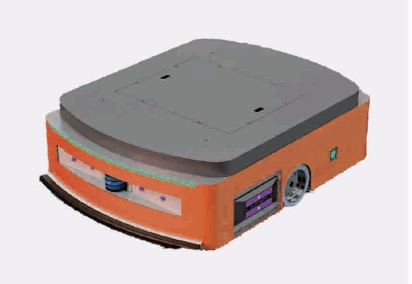
Tug AGV Drive Architecture
The standard tug AGV drive system consists of five core components:
- Two BLDC drive motors — left and right, independently controlled for differential steering
- Planetary or helical gearboxes — one per motor, reducing speed and multiplying torque
- Electromagnetic brakes — spring-applied, power-off fail-safe on each drive motor
- Dual-channel motor controller — FOC or trapezoidal commutation, CAN bus interface
- Drive wheels — polyurethane-on-steel, 150-300mm diameter, mounted directly to gearbox output shaft
This architecture enables the tug AGV to steer by running the two motors at different speeds (differential drive). Turning left means the left motor runs slower than the right motor. Spinning in place means the motors run in opposite directions. The dual-channel BLDC controller synchronizes both motors and communicates with the AGV's navigation computer via CAN bus.
BLDC Motor Sizing for Tug AGVs
Motor sizing starts with understanding the forces the tug AGV must overcome. The motor torque calculation follows this methodology:
Step 1: Calculate Total Traction Force
Total force = Rolling resistance + Gradient force + Acceleration force
| Force Component | Formula | Notes |
|---|---|---|
| Rolling resistance | Fr = (Mtug + Mload) x g x Crr | Crr = 0.01-0.02 for PU wheels on concrete |
| Gradient force | Fg = (Mtug + Mload) x g x sin(theta) | 5% grade = 490N per 1,000 kg |
| Acceleration force | Fa = (Mtug + Mload) x a | Typical a = 0.3-0.5 m/s2 for tug AGVs |
Step 2: Calculate Motor Power
Power per motor = (Ftotal / 2) x v / eta
Where v is travel speed (m/s) and eta is drivetrain efficiency (typically 0.70-0.85 depending on gearbox type). The division by 2 accounts for the dual-motor configuration.
Step 3: Full Sizing Table
Here is our standard motor sizing table for tug AGVs on flat concrete (Crr = 0.015), used by our OEM customers as a starting point:
| Tow Capacity | AGV Weight | Speed | Motor (each) | Gear Ratio | Wheel | Voltage | Our Model |
|---|---|---|---|---|---|---|---|
| 1 ton | 200 kg | 1.2 m/s | 200W | 15:1 planetary | 150mm PU | 24V | BL-60 planetary |
| 2 tons | 350 kg | 1.0 m/s | 400W | 20:1 planetary | 200mm PU | 24V | BL-80 planetary |
| 5 tons | 600 kg | 1.0 m/s | 750W | 30:1 planetary | 250mm PU | 48V | BL-104 R-type |
| 10 tons | 800 kg | 0.8 m/s | 1,500W | 40:1 planetary | 250mm PU | 48V | BL-120 high-power |
| 20 tons | 1,200 kg | 0.6 m/s | 2,000W | 50:1 helical | 300mm PU | 48V | BL-120 L-type |
| 30 tons | 1,500 kg | 0.5 m/s | 3,000W | 50:1 helical | 300mm PU | 48-72V | BL-130 high-power |
Important: These ratings are for flat-floor continuous operation. If your tug AGV must handle ramps, dock levelers, or accelerate quickly, add 50-100% to the motor power. Our high-power BLDC motors can deliver 2-3x rated power for short bursts (10-30 seconds) during slope climbing.
Need a drive system quote for your tug AGV project? Share your towing capacity and we'll recommend a matched configuration.
Get a Drive Recommendation →Gear Ratio Selection for Tug AGVs
The gear ratio determines the trade-off between wheel torque and travel speed. The calculation starts from desired wheel speed:
Gear ratio = Motor RPM / Wheel RPM
Where Wheel RPM = (v x 60) / (pi x D). For a 1.0 m/s speed with a 250mm wheel: Wheel RPM = (1.0 x 60) / (3.14159 x 0.25) = 76.4 RPM. With a 3,000 RPM motor: Gear ratio = 3,000 / 76.4 = 39.3:1.
Practical gear ratio ranges by tug AGV class:
| Tug AGV Class | Gear Ratio | Gearbox Type | Efficiency | Why This Type |
|---|---|---|---|---|
| Light (1-2T) | 15:1 - 25:1 | Planetary (1-2 stage) | 90-95% | Compact, high efficiency, low noise |
| Medium (2-5T) | 20:1 - 35:1 | Planetary (2 stage) | 85-92% | Best torque density per volume |
| Heavy (5-15T) | 30:1 - 50:1 | Helical (R-type) | 92-96% | High efficiency at large ratios |
| Extra-heavy (15-30T) | 40:1 - 80:1 | Helical + worm (L-type) | 60-85% | Self-locking for slope holding |
For more detail on planetary gearbox selection, see our BLDC planetary gear motor guide.
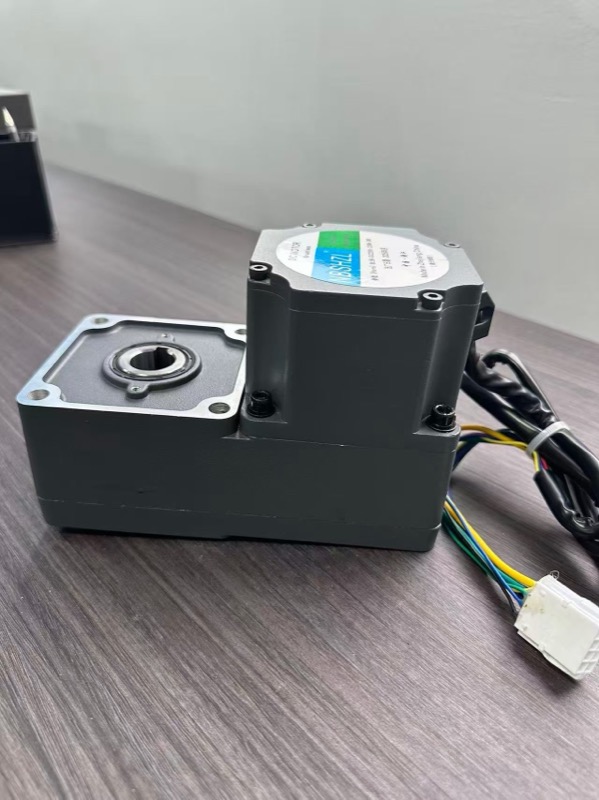
Electromagnetic Brake Requirements
Electromagnetic brakes are mandatory for tug AGVs. ISO 3691-4 (industrial truck safety for driverless vehicles) requires automatic braking when the AGV loses power, communication, or detects an obstacle. Spring-applied, power-off brakes are the standard solution.
Brake sizing: the brake must hold the full towing load on the steepest expected gradient.
Brake holding torque = (Mtotal x g x sin(theta) x rwheel) / (2 x gear ratio x safety factor)
For a 5-ton tug AGV on a 5% slope with 250mm wheels, 30:1 gear ratio, and 1.5x safety factor:
Tbrake = (5,600 x 9.81 x 0.05 x 0.125) / (2 x 30 x 1.5) = 3.8 N.m per motor
We recommend selecting a brake with at least 2x the calculated holding torque. Our standard 24V electromagnetic brakes range from 2 N.m to 40 N.m, covering the full tug AGV range. See our electromagnetic brake sizing guide for detailed calculations.
Battery and Runtime Calculation
Tug AGVs typically run 8-16 hours per charge. Battery capacity depends on motor power, duty cycle and desired runtime.
Battery capacity (Ah) = (Ptotal x duty cycle x runtime) / (Vbus x DoD x etabattery)
For a 5-ton tug AGV with dual 750W motors, 40% duty cycle, 48V bus, 80% depth of discharge, 10-hour target:
Capacity = (1,500 x 0.4 x 10) / (48 x 0.8 x 0.95) = 164 Ah
Practical recommendation: 48V 200Ah LiFePO4 pack (9.6 kWh), which gives approximately 12 hours runtime with 20% reserve. LiFePO4 is the standard for tug AGVs due to its thermal stability, 3000+ cycle life, and flat discharge curve that maintains consistent motor performance.
For voltage selection guidance (24V vs 48V): light-duty tug AGVs (1-2 tons) can use 24V to simplify the BMS. Medium and heavy-duty models should use 48V to keep current draw manageable and reduce cable weight.
Controller and Communication Interface
The tug AGV's motor controller serves as the bridge between the navigation computer and the drive motors. Key requirements:
- Dual-channel output — independently controls left and right motors for differential steering
- CAN bus interface — receives speed/direction commands from the AGV navigation controller at 1 ms refresh rate
- FOC commutation — Field Oriented Control provides smooth torque at all speeds, critical for precise path following
- Regenerative braking — recovers energy during deceleration, extending battery runtime 5-10%
- Encoder feedback — 1000+ PPR incremental encoder for odometry (dead reckoning between navigation waypoints)
- Safety inputs — emergency stop, zone speed limiting, bumper contact triggers
Our dual-channel BLDC controllers are designed specifically for AGV applications, with CAN bus (CANopen or custom protocol), RS485, and analog speed input modes.
Tug AGV vs Electric Tugger vs Manual Tow Tractor
Understanding the differences helps equipment designers choose the right drive system architecture:
| Feature | Manual Tow Tractor | Electric Tugger | Tug AGV |
|---|---|---|---|
| Operator | Required (ride-on) | Required (walk-behind/ride-on) | None (autonomous) |
| Navigation | Manual steering | Manual steering | Magnetic/laser/SLAM |
| Motor type | AC induction or brushed DC | BLDC or AC | BLDC (dominant) |
| Speed control | Basic (throttle) | Variable speed | Precise FOC + encoder |
| Communication | None | None or basic | CAN bus + Wi-Fi/5G |
| Labor cost | 1 operator per tractor | 1 operator per tugger | 1 supervisor per 5-10 AGVs |
| ROI period | N/A (baseline) | N/A | 12-24 months vs manual |
For more on this comparison, read our AGV electric tug vs manual tow tractor analysis. If you are deciding between motor technologies, see our BLDC vs AC induction motor comparison for AGV tugs.
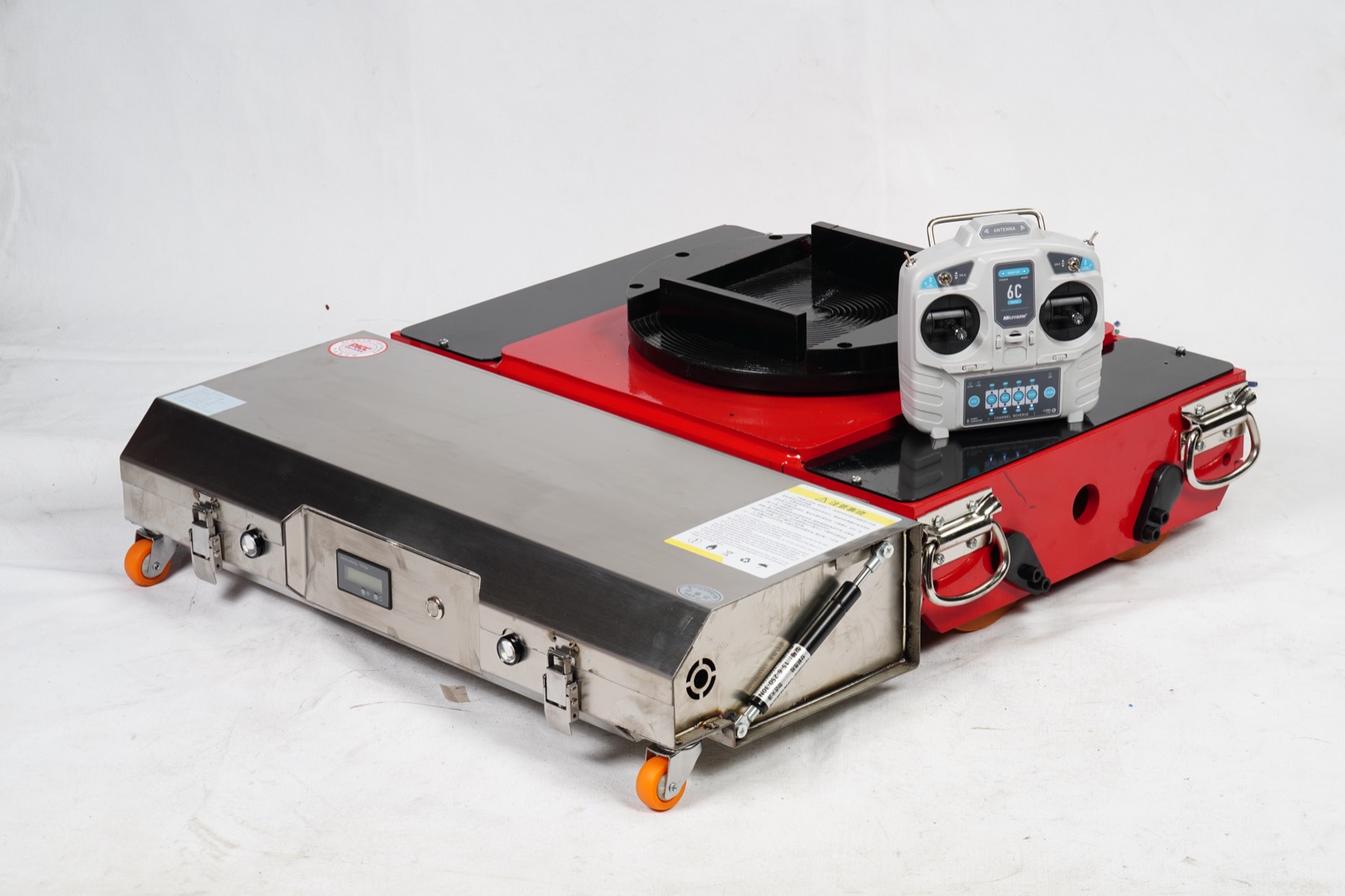
Design Checklist for Tug AGV Drive Systems
Before requesting a quote from a motor supplier, prepare these specifications:
- Maximum towing capacity (kg) — the heaviest loaded cart train the AGV must pull
- AGV self-weight (kg) — including battery, chassis, electronics
- Travel speed (m/s) — both maximum and typical operating speed
- Drive wheel diameter (mm) — typically 150-300mm for tug AGVs
- Maximum gradient (%) — even 2-3% dock ramps matter for motor sizing
- Floor surface — smooth concrete, epoxy, steel plate, outdoor asphalt
- Bus voltage — 24V or 48V (48V preferred for >2 ton capacity)
- Communication protocol — CAN bus (CANopen/J1939), RS485, analog
- Safety requirements — ISO 3691-4, ANSI B56.5, or other regional standards
- Runtime requirement (hours per charge)
With these parameters, our engineering team can recommend a complete drive package — motors, gearboxes, brakes, controller, encoder, and wiring — matched and pre-tested as a system.
Frequently Asked Questions
What is a tug AGV?
A tug AGV (Automated Guided Vehicle) is a driverless battery-powered vehicle that autonomously tows carts, trolleys and trailers along programmed routes in factories and warehouses. Unlike forklift AGVs, tug AGVs pull wheeled loads using a hitch mechanism. They typically use dual BLDC motors (200W-3kW) with differential steering for precise path following.
What motor power does a tug AGV need?
Motor power depends on towing capacity: 1-2 ton tug AGVs use dual 200-400W BLDC motors, 3-5 ton models use dual 400-750W, 5-10 ton use dual 750W-1.5kW, and 10-30 ton heavy-duty tug AGVs use dual 1.5-3kW. Always add 50-100% for ramps and acceleration.
Why do tug AGVs use BLDC motors instead of AC motors?
BLDC motors offer 85-92% efficiency (15-25% longer battery life), flat torque from zero RPM for smooth starts under load, 40-50% smaller size, and Hall sensor feedback for precise speed control and path following via CAN bus.
What is the difference between a tug AGV and an electric tugger?
An electric tugger requires a human operator. A tug AGV is fully autonomous with navigation guidance (magnetic tape, laser, SLAM), CAN bus communication, encoders for odometry, and electromagnetic brakes for ISO 3691-4 safety compliance.
What gear ratio should a tug AGV motor use?
Light-duty (1-3T): 15:1-25:1 planetary. Medium (2-5T): 20:1-35:1 planetary. Heavy (5-15T): 30:1-50:1 helical. Extra-heavy (15-30T): 40:1-80:1 helical+worm. Planetary gearboxes are preferred for their 90-95% efficiency which directly extends battery runtime.
Building a Tug AGV? Let Us Size Your Drive System.
Share your towing capacity, speed and voltage requirements. Our engineers will recommend a matched motor + gearbox + controller + brake package within 24 hours.