
Most incoming inspections on BLDC motors check the wrong things. Buyers measure phase resistance with a two-wire multimeter, re-hipot every motor at full voltage, and test Hall sensors without pull-up resistors — then reject a good lot or, worse, pass one with a substituted magnet. We ship motors to AGV, conveyor and mobile-machinery builders every week, and this is the inspection plan we would want our own customers to run on us.
Quick Answer
- Sample by ISO 2859-1, Level II. 50 motors from a 281–500 lot, 80 from 501–1,200, 125 from 1,201–3,200. Critical defects are zero-acceptance; majors at AQL 1.0; cosmetics at AQL 2.5–4.0.
- Twelve checks cover it: packaging, label, leads, shaft and runout, phase resistance, insulation resistance, hipot, Hall sequence, back-EMF, no-load current, noise and backlash, brake.
- Hipot at 80%, not 100%. IEC 60034-1 requires 596 V AC for a 48 V motor under 1 kW; the factory already applied it, so repeat at about 480 V.
- Insulation: above 100 MΩ at 500 V DC on a new motor. IEEE 43’s 5 MΩ is a floor for old motors, not an acceptance limit.
- Back-EMF is your fraud detector. A Ke 8–10% low across all samples usually means N35 magnets where N42 was quoted.
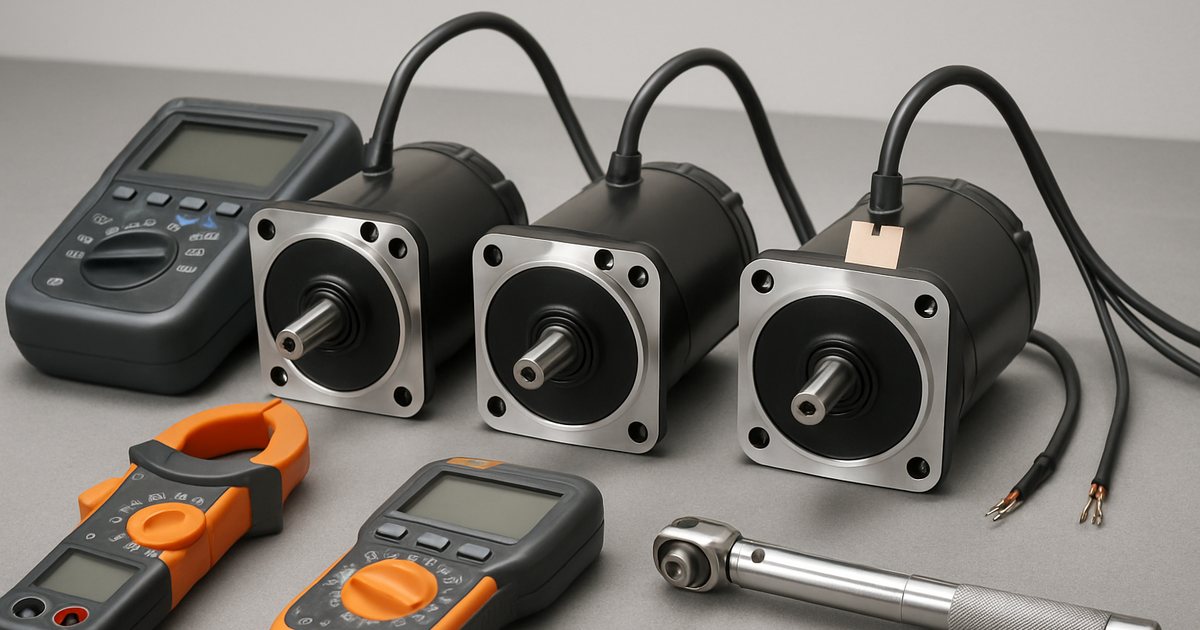
Why Incoming Inspection Goes Wrong on BLDC Motors
A brushless motor looks like a sealed black cylinder. Almost everything that decides whether it will run 20,000 hours — magnet grade, winding insulation, Hall alignment, bearing grease — is invisible. So the inspection has to be electrical, and electrical measurements on low-voltage motors are easy to get wrong.
These are the three errors we see most often in customer inspection reports:
- Two-wire resistance measurement. A 200 W, 48 V motor has 0.3–0.6 Ω phase-to-phase. Meter leads and contacts add 0.1–0.3 Ω. That is a 30–60% error before you start, and it varies with how hard you press the probes.
- Full-voltage hipot on every motor, every time. The factory, the inspection agency and the buyer each hipot the same winding at 100%. Each application consumes some insulation life. IEC 60034-1 tells you to repeat at 80%.
- Hall sensors tested without pull-ups. Most BLDC Hall outputs are open-collector. With no 4.7–10 kΩ pull-up to 5 V, the output floats and the meter shows random values — and a good motor gets rejected for “dead Halls”.
Transit adds its own failure modes: shafts knocked during forklift handling, connectors crushed in cartons, and condensation inside motors that crossed the equator in a sealed container. A good plan catches those without re-testing what the factory has already proven.
Sampling Plan: How Many Motors to Test
Use ISO 2859-1 (identical in practice to ANSI/ASQ Z1.4), General Inspection Level II, single sampling, normal inspection. First classify every check as critical, major or minor, then look up the sample size and accept/reject numbers.
| Defect class | Examples on a BLDC motor | AQL | Consequence |
|---|---|---|---|
| Critical | Hipot breakdown, insulation below limit, brake does not hold, phase shorted to frame | 0 — zero acceptance | One failure rejects the lot; 100% re-test at factory cost |
| Major | Resistance or Ke out of tolerance, wrong Hall sequence, no-load current high, runout over limit, wrong connector pinout | 1.0 | Lot rejected above Ac |
| Minor | Paint scuff, label misaligned, carton damage without product damage | 2.5–4.0 | Recorded, corrective action requested |
| Lot size | Code letter | Sample size | AQL 1.0 Ac/Re | AQL 2.5 Ac/Re | AQL 4.0 Ac/Re |
|---|---|---|---|---|---|
| 151–280 | G | 32 | Use n=50 plan: 1/2 | 2/3 | 3/4 |
| 281–500 | H | 50 | 1/2 | 3/4 | 5/6 |
| 501–1,200 | J | 80 | 2/3 | 5/6 | 7/8 |
| 1,201–3,200 | K | 125 | 3/4 | 7/8 | 10/11 |
ISO 2859-1 Tables 1 and 2-A, General Level II, normal single sampling. Ac = accept if defectives found are at or below this number; Re = reject at this number or above. Always check a new plan against the standard itself — several free online AQL tables shift the rows by one code letter.
Small lots: at our usual MOQ of 50–100 pieces, Level II asks for 13–20 samples and the arrows in the master table push you to larger plans anyway. Below about 150 motors, run the electrical checks (points 5–10 below) on every motor. It takes one technician roughly a day, and it gives you a baseline dataset for every later order.
Want the limits agreed before production starts? We attach a pass/fail sheet to every PO and ship serial-numbered test data with the motors — send us your application details and we will draft one for your drive.
The 12-Point BLDC Motor Inspection Checklist
| # | Check | Tool | Pass criterion | Class |
|---|---|---|---|---|
| 1 | Packaging & transit damage | Visual | No crushed cartons, shaft caps fitted, desiccant present on sea freight | Minor / Major |
| 2 | Label, model, serial/date code | Visual vs PO | Matches PO and test report serials | Major |
| 3 | Lead colours, length, connector pinout | Ruler, pinout sheet | Per drawing; length ±10 mm | Major |
| 4 | Shaft diameter, key, runout | Micrometer, dial indicator | h6/k6 fit; runout per IEC 60072-1 (table below) | Major |
| 5 | Phase-to-phase resistance | 4-wire milliohm meter | ±7% of datasheet at 20 °C; phases within 3–5% of each other | Major |
| 6 | Insulation resistance | 500 V DC insulation tester | ≥ 100 MΩ, phases to frame | Critical |
| 7 | Hipot (dielectric withstand) | AC hipot tester | 80% of IEC 60034-1 value, 1 min (or 1 s at 120% on a production line), no breakdown, leakage below 5 mA | Critical |
| 8 | Hall sequence & duty | 5 V supply, pull-ups, scope or meter | Six valid states, never 000 or 111; each Hall 50% ±5% duty | Major |
| 9 | Back-EMF constant Ke | Oscilloscope | ±7% of nominal; phase balance within 3% | Major |
| 10 | No-load current & speed | Controller, clamp meter, tachometer | Current ≤ datasheet +20% after 5 min run-in; speed ±5% | Major |
| 11 | Noise, vibration, gearbox backlash | Sound meter, dial indicator | ≤ 60 dB(A) at 1 m; backlash within datasheet | Major / Minor |
| 12 | Brake release & holding torque | Variable supply, torque wrench | Releases at ≤ 85% rated coil voltage; holds rated static torque | Critical |
Tolerances are the limits we print on our own datasheets for standard L-type, R-type and planetary gear BLDC motors. If your supplier’s datasheet quotes different tolerances, write theirs into the PO before production.
Electrical Tests, Step by Step
Phase resistance — correct it to 20 °C
Copper resistance rises 0.393% per °C. Datasheets quote resistance at 20 °C; your warehouse is not at 20 °C. Correct every reading with R20 = Rt ÷ (1 + 0.00393 × (t − 20)), where t is the motor temperature after it has sat in the room for at least 4 hours.
| Motor temperature | Correction factor | A 0.500 Ω winding reads | Error if uncorrected |
|---|---|---|---|
| 5 °C (winter dock) | 0.941 | 0.471 Ω | −5.9% |
| 20 °C (datasheet) | 1.000 | 0.500 Ω | 0% |
| 35 °C (summer warehouse) | 1.059 | 0.529 Ω | +5.9% |
| 45 °C (just after run test) | 1.098 | 0.549 Ω | +9.8% — false reject |
Absolute value tells you the winding matches the design; balance tells you it was wound correctly. One phase 8% higher than the other two on a single motor points to a bad crimp or a strand broken at the lead-out — a major defect even if the average is in tolerance. See our winding, Kt and Kv guide for how resistance ties to current draw and copper loss.
Insulation resistance and hipot — protect the winding you are testing
Short the three phase leads together. Tie the Hall, encoder and thermistor leads to the motor frame — leaving sensor leads floating during a hipot can put several hundred volts across the Hall ICs. Then measure insulation resistance at 500 V DC for 60 seconds, followed by the AC withstand test.
| Motor | IEC 60034-1 test voltage (1 min) | Repeat test at 80% | Insulation resistance to accept |
|---|---|---|---|
| 24 V, under 1 kW | 500 + 2×24 = 548 V AC | ~440 V AC | ≥ 100 MΩ at 500 V DC |
| 48 V, under 1 kW | 500 + 2×48 = 596 V AC | ~480 V AC | ≥ 100 MΩ at 500 V DC |
| 48 V, 1 kW and above | 1,000 + 2×48 = 1,096 → 1,500 V AC minimum | 1,200 V AC | ≥ 100 MΩ at 500 V DC |
| 72–96 V, 1–3 kW | 1,000 + 2×(72–96) = 1,144–1,192 → 1,500 V AC minimum | 1,200 V AC | ≥ 100 MΩ at 500 V DC |
Our production line tests every winding at 1,500 V AC regardless of rating — well above the IEC minimum for low-voltage motors. IEEE 43 lists 5 MΩ as the minimum for random-wound windings below 1 kV; treat that as the level at which an in-service motor must be dried or retired, not as an acceptance limit for new product.
Hall sensors — sequence, not just “signal present”
Power the Hall board at its rated voltage (usually 5 V), fit 4.7–10 kΩ pull-ups on each output, and turn the shaft slowly. A 120° Hall set steps through six states and never shows 000 or 111; spun steadily, each output sits high for 50% ±5% of the cycle. A Hall that is present but mis-positioned by more than about 5 electrical degrees will not fail a meter test — it shows up as higher no-load current and noise in point 10. Our Hall sensor guide has the full commutation table.
Back-EMF — the one test that catches a magnet swap
Resistance can be perfect on a motor with cheaper magnets. Ke cannot. Measure it by coast-down: run the motor at no load on its controller, disable the output stage so it goes high-impedance, and capture line-to-line voltage on a scope as the rotor coasts. Mechanical speed (rpm) = 60 × electrical frequency ÷ pole pairs. Ke (V/krpm) = peak line-line voltage ÷ (rpm ÷ 1,000).
Sintered NdFeB grade N35 has a remanence of about 1.17–1.22 T; N42 is about 1.28–1.32 T. Swap one for the other and flux, Ke and torque per amp all drop 8–10%. Every sample reading low by a similar amount is the signature — the motor will run, draw more current at load, and run hotter in your application. Ke also falls about 0.1% per °C with magnet temperature, so measure cold.
No-load current — let the grease warm up
On a gear motor, most no-load current is gearbox and seal drag. At a 5 °C receiving dock, cold grease can push it 30–50% above the datasheet figure. Run each sample for 5 minutes before reading. If it is still more than 20% above the datasheet warm, suspect a tight bearing, a misaligned gearbox or a Hall offset. Our troubleshooting guide maps each symptom to a root cause.
Mechanical, Gearbox and Brake Checks
| Shaft extension diameter | Max. runout, normal class (IEC 60072-1) |
|---|---|
| up to 10 mm | 0.030 mm |
| over 10 to 18 mm | 0.035 mm |
| over 18 to 30 mm | 0.040 mm |
| over 30 to 50 mm | 0.050 mm |
Measure with a dial indicator at the middle of the shaft extension while turning the shaft by hand. On gear motors, measure the output shaft of the gearbox.
- Backlash. Lock the motor shaft, rock the output shaft with a light torque, and read the arc at a known radius with a dial indicator. Our standard planetary gearboxes are specified at ≤ 15 arcmin single-stage and ≤ 20 arcmin two-stage; precision versions are tighter. Compare with your supplier’s datasheet, not with ours.
- Noise. Run at rated speed, no load, microphone 1 m away, background at least 10 dB quieter. A gear whine that is 5 dB louder on one sample than the rest usually means a damaged tooth from a shaft impact in transit.
- Brake. Ramp the coil voltage up slowly and note where the armature pulls in — it should release at 85% of rated coil voltage or less, so a sagging battery does not leave the brake dragging. Then check static holding torque with a torque wrench on the shaft. The electromagnetic brake guide covers engage time and wiring.
- IP rating. Do not water-test samples you intend to use. Check that seals, gland nuts and connector boots are present and seated; IP65 means dust-tight and protected against water jets per IEC 60529, and a missing gland o-ring defeats it completely.
Documents to Demand With Every Shipment
A good supplier makes most of your inspection a paperwork check. With each shipment, ask for:
- Serial-numbered final test records — resistance, insulation resistance, hipot result, no-load current and speed for every motor, not a single “typical” sheet.
- Certificate of conformity referencing your PO, drawing revision and the datasheet revision.
- Material declarations — RoHS and REACH statements tied to the model number.
- Packing list with serial ranges per carton, so you can draw a random sample without opening every box.
- Notice of any change since the last lot — magnet supplier, bearing brand, grease, Hall IC, connector. Silent changes are the most common source of “same model, different motor”. For how medical buyers formalise this, see what ISO 13485 requires from a motor supplier.
With serial-numbered data in hand you can compare your incoming readings to the factory’s for the same motor. If your phase resistance matches theirs within 2% after temperature correction, your meter and theirs agree and you can drop to a reduced plan on future lots.
Setting Up an Inspection Bench: Equipment and Cost
| Equipment | Used for checks | Typical 2026 price | Can you skip it? |
|---|---|---|---|
| 4-wire (Kelvin) milliohm meter | 5 | $300–$900 | No — a multimeter cannot resolve sub-ohm windings |
| Insulation tester, 500/1,000 V DC | 6 | $150–$600 | No |
| AC hipot tester, 0–5 kV | 7 | $600–$2,500 | Yes, if you hold serial-numbered factory hipot records |
| 2-channel oscilloscope | 8, 9 | $350–$700 | No — needed for Ke |
| DC supply 60 V / 20 A or battery + your controller | 10, 12 | $300–$800 | Use your own controller if you have one |
| Clamp meter, tachometer, sound meter | 10, 11 | $150–$400 total | No |
| Dial indicator + magnetic base, torque wrench | 4, 11, 12 | $150–$350 | No |
| Total | about $2,000–$6,000 |
Street prices for bench-grade instruments, September 2026. A full electrical sequence (checks 5–10) takes 6–8 minutes per motor once the fixture is set up.
Inspect at the Factory or on Arrival?
| Approach | Typical cost | What it catches | If the lot fails |
|---|---|---|---|
| Agreed limits + factory serial data | Free with a capable supplier | Electrical and assembly defects | Fixed before packing |
| Third-party pre-shipment inspection | ~$300 per man-day in Ningbo; ~50 motors per day | Electrical, mechanical, labeling, packing | Re-work at origin, days of delay |
| Full incoming inspection only | Your technician time + bench | Everything, including transit damage | Return freight, possibly unrecoverable duty, 6–10 weeks lost |
| Reduced incoming check after PSI | 2–3 hours per lot | Transit damage, condensation, mix-ups | Usually a few units, replaced under warranty |
The combination we recommend: limits written into the PO, factory serial data with every lot, a pre-shipment inspection on the first two or three orders, then a reduced incoming check once your readings and the factory’s agree. If you are importing for the first time, our China BLDC motor import guide covers supplier evaluation, shipping and payment terms.
Frequently Asked Questions
How many BLDC motors should I test from a shipment?
Use ISO 2859-1 General Level II, single sampling, normal inspection: 50 samples from a lot of 281–500, 80 from 501–1,200, 125 from 1,201–3,200. At AQL 1.0 for majors you accept 1, 2 or 3 defectives respectively. Critical defects — hipot or insulation failure, a brake that does not hold — are zero-acceptance. Under about 150 motors, test the electricals on every unit; it takes about a day.
What hipot voltage should I use to test a BLDC motor?
IEC 60034-1 sets 500 V + 2U for machines under 1 kW and under 100 V, and 1,000 V + 2U with a 1,500 V minimum for other low-voltage machines, for one minute. A 48 V, 400 W motor needs 596 V AC. Because the factory has already applied that, repeat at 80% — about 480 V — as IEC 60034-1 allows for repeat tests. Short the phases, tie sensor leads to the frame, trip at 5 mA.
What insulation resistance is acceptable for a new BLDC motor?
At 500 V DC, phases to frame, a new dry low-voltage BLDC motor should read above 100 MΩ; ours typically read several hundred. IEEE 43’s 5 MΩ for random-wound windings below 1 kV is a floor for in-service motors, not an acceptance limit. A new motor under about 20 MΩ has moisture, a damaged lead exit or a pinched winding — quarantine it.
Why does my multimeter show different phase resistances on identical motors?
A two-wire meter adds 0.1–0.3 Ω of lead and contact resistance — a 30–60% error on a 0.3–0.6 Ω winding. Use a four-wire milliohm meter. Then correct for temperature: copper rises 0.393% per °C, so a motor at 35 °C reads 5.9% above its 20 °C datasheet value. Judge balance too: three readings on one motor should agree within 3–5%.
How can I check back-EMF without a dynamometer?
Coast-down: run the motor at no load, disable the controller output, and scope the line-to-line voltage as the rotor coasts. Speed in rpm = 60 × electrical frequency ÷ pole pairs; Ke = peak voltage ÷ (rpm ÷ 1,000). Every sample reading 8–10% low usually means N35 magnets were used where N42 was quoted.
Is it cheaper to inspect BLDC motors in China before shipping?
Almost always. A third-party pre-shipment inspection around Ningbo costs roughly $300 per man-day and covers about 50 motors. Rejecting a landed lot costs return freight, duty you may not recover and 6–10 weeks. Agree limits before production, get serial data with the shipment, inspect at origin for the first orders, then run a reduced check on arrival for transit damage.
Request a Quote With Test Data Included
Every motor we ship carries serial-numbered resistance, insulation, hipot and no-load records. Tell us your application and inspection limits and we will quote the drive with a matching pass/fail sheet. MOQ 50 pcs, samples in 7–10 days.