
Search for a brushless motor supplier with ISO 13485 and you will find catalogue pages with a certificate logo and very little else. That logo answers the wrong question. ISO 13485 is your quality system as the device manufacturer; what it asks of a motor supplier is set by your own risk assessment and written into your purchasing documents. We are an ISO 9001 motor factory, not an ISO 13485 one, and we supply drives for hospital beds, patient-handling equipment and hospital logistics vehicles under our customers’ supplier controls. This guide explains how that works and when it is not enough.
Quick Answer
- Not a legal requirement. FDA’s QMSR (21 CFR 820, incorporating ISO 13485:2016, effective February 2, 2026) still states in 820.1(a)(2) that it does not apply to manufacturers of components or parts.
- The obligation is yours. ISO 13485 clause 7.4.1 requires you to evaluate and select suppliers by their ability to supply conforming product, proportionate to risk; 7.4.2 requires a written agreement that the supplier notifies you of changes before implementing them.
- When to insist on a certified supplier: life-sustaining or implantable devices, drives where the motor supplier also owns the design, and cases where your notified body expects it.
- For hospital beds, patient lifts, powered wheelchairs, carts and logistics robots, an ISO 9001 motor maker plus a supplier quality agreement, first-article inspection and serial-numbered test data is the usual route.
- Keep the motor on the SELV side of a medical power supply and it stays out of the 4,000 V AC, 2 MOPP insulation path.
What an ISO 13485 Certificate Actually Covers
ISO 13485:2016 is a quality management system standard for organisations involved in the life cycle of medical devices. A certificate says an accredited body audited a site’s processes against it. It does not approve a product, and it does not transfer your regulatory responsibility to the supplier.
| Question | What the certificate tells you | What it does not tell you |
|---|---|---|
| Who is certified? | A named site and scope, e.g. “design and manufacture of DC motors” | Whether the line making your motor is inside that scope |
| Is the motor approved? | Nothing — there is no product approval in ISO 13485 | Whether it suits your device, environment or risk class |
| Will FDA accept it? | FDA says it will not require certificates and a certificate does not exempt anyone from inspection | — |
| Are changes controlled? | The supplier has a change process | That it will notify you — only your written agreement does that |
That last row is the one that matters most. The European certificate on a catalogue page and the notification clause in your supplier agreement are different things; only the second one protects your design history file when a magnet or grease changes.
Does Your Motor Supplier Need ISO 13485? A Risk-Based Answer
ISO 13485 clause 7.4.1 tells you to set supplier criteria based on their ability to provide conforming product and on the risk the purchased product carries in your device. So start from the device and from what happens if the motor fails.
| Device (US classification) | Motor role | Failure consequence | Typical supplier route |
|---|---|---|---|
| AC-powered adjustable hospital bed (21 CFR 880.5100, Class II) | Height and backrest actuators | Loss of adjustment; mechanically self-holding | ISO 9001 + SQA + FAI |
| AC-powered patient lift (21 CFR 880.5500, Class II) | Lift drive | Load must be held — brake and gearbox matter | ISO 9001 + SQA + FAI + brake verification |
| Powered wheelchair (21 CFR 890.3860, Class II) | Traction motors | Loss of mobility; braking on slopes | ISO 9001 + SQA + FAI; audit recommended |
| Hospital logistics robot or cart tug | Traction drive | Usually not a medical device; industrial safety standards apply | ISO 9001; standard industrial controls |
| Infusion pump (21 CFR 880.5725, Class II) | Pumping mechanism | Dosing error — high patient risk | ISO 13485 supplier preferred, or deep audit |
| Ventilator blower, implantable pump | Life-sustaining function | Patient harm or death | ISO 13485 supplier with medical design history |
Classifications are for the finished device in the US; confirm current product codes in the FDA classification database. EU MDR classes differ — hospital beds and wheelchairs are generally Class I in the EU, while infusion pumps and ventilators sit in higher classes. Our drives are designed for the rows marked green.
Notice what drives the answer: failure consequence, not the word “medical”. A 200 W gear motor in a patient lift is mechanically similar to one in an AGV tug; what changes is the brake verification, traceability and change control around it.
Working on a bed, lift, wheelchair or hospital cart drive? Send us the load, duty cycle and supply voltage — we will propose a motor and the controls we can support under your supplier agreement.
What ISO 13485 Clause 7.4 Asks You to Get From a Motor Supplier
| Clause | Requirement (paraphrased) | What that means for a BLDC motor | Evidence to collect |
|---|---|---|---|
| 7.4.1 | Evaluate and select suppliers by ability and risk; monitor and re-evaluate | Audit winding, magnetising, balancing, final test; review field returns | Audit report, approved supplier list entry, annual scorecard |
| 7.4.2 | Purchasing information, including written agreement to notify changes before implementation | Drawing and datasheet revision on every PO; change notification clause | Signed SQA, PO terms |
| 7.4.3 | Verify purchased product, extent based on supplier evaluation and risk | Incoming inspection plan, or reliance on supplier data plus audit | Inspection records, serial-numbered supplier test data |
| 4.2.5 | Retain records for at least device lifetime, not less than two years from release | Supplier keeps test and lot records at least that long | Retention period stated in SQA |
| 7.5.8 / 7.5.9 | Identification and traceability | Serial or date code per motor, linked to magnet, wire, bearing and Hall lots | Traceability test: pick a serial, ask for its lot records |
For clause 7.4.3, our BLDC motor incoming inspection checklist gives the sampling plan and pass/fail limits most teams start from: phase resistance, insulation, hipot, Hall sequence, back-EMF and no-load current.
The Change Notification List: 10 Motor Changes That Must Trigger a PCN
“Notify us of significant changes” is too vague to enforce. List the changes. These are the ones we have seen alter a motor’s behaviour without changing its part number:
| Change | Why it matters in a medical device |
|---|---|
| Magnet grade or magnet supplier | Ke and torque per amp shift 8–10% between N35 and N42 — more current, more heat, different stall torque |
| Magnet wire supplier or insulation class | Thermal endurance and hipot margin |
| Varnish or impregnation process | Moisture resistance — relevant to devices that are wiped down with disinfectants |
| Bearing brand or grease | Acoustic noise at the bedside, cold-start current, bearing life |
| Gear material or heat treatment | Backlash growth, noise and shock-load capacity in lifts |
| Hall sensor IC part number | Switching thresholds and supply range; can cause intermittent commutation faults |
| Lead wire, connector or cable gland | Strain relief, ingress protection, EMC behaviour |
| Controller firmware | Current limits, braking behaviour, fault responses — effectively a design change |
| Production line or factory move | Every validated process is new again |
| New subcontractor for any process | Winding, machining or magnetising done outside your audited site |
Supplier Quality Agreement Checklist for BLDC Motors
- Frozen configuration: drawing number and revision, datasheet revision, approved sub-supplier list for magnets, wire, bearings and Hall ICs.
- Change notification: the list above, a notice period (90–180 days is common), and your right to request samples from the changed process before approval.
- Traceability: serial or date code on every motor, mapped to component lots, retrievable within an agreed time.
- Test records: serial-numbered final test data shipped with each lot; retention for at least the device lifetime and not less than two years.
- First-article inspection: full dimensional and electrical report on the first production lot, repeated after any approved change.
- Nonconformance handling: containment within 24–48 hours, root cause and corrective action (8D or equivalent) within an agreed period.
- Continuity of supply: last-time-buy notice of 6–12 months before any discontinuation.
- Compliance declarations: RoHS and REACH statements per model; conflict-minerals information if your customers require it.
- Audit rights: announced audits by you or your notified body, with reasonable notice.
None of these require the supplier to hold an ISO 13485 certificate. All of them require a supplier willing to sign them and able to produce the records. Test that before you commit: pick a serial number from a sample shipment and ask for its component lot records.
Where the Motor Meets IEC 60601-1 and IEC 60601-1-2
Motors are not certified to IEC 60601-1 on their own; they are assessed as part of the medical electrical equipment. The biggest decision is where the motor sits in your insulation diagram.
| Architecture | Motor’s role in patient protection | Insulation the motor needs | Cost impact |
|---|---|---|---|
| 24/48 V BLDC motor behind a medical-grade power supply | Outside the MOPP path — the power supply provides the barrier | Motor standard levels, e.g. 596 V AC for a 48 V motor under 1 kW (IEC 60034-1) | Standard motor, standard price |
| Mains-connected motor in the patient environment | Part of the barrier | 2 MOPP at 250 V: 4,000 V AC test, 8 mm creepage | Special insulation system, custom tooling |
That is one reason bed, lift and wheelchair designs have moved to low-voltage BLDC drives. The other is EMC: IEC 60601-1-2 emissions are assessed to CISPR 11, with Class B limits for the home healthcare environment. The motor-and-controller pair is usually the largest noise source in the product. Sinusoidal (FOC) commutation, shielded phase leads terminated 360° at the controller and short cable runs do more than any filter added later — see our controller selection guide and the matched BLDC controllers we supply.
How to Qualify an ISO 9001 Motor Supplier in 6 Steps
| Step | What happens | Typical duration |
|---|---|---|
| 1. Questionnaire | QMS scope, test equipment, sub-supplier list, change process | 1 week |
| 2. Audit | Remote or on-site against your 7.4 checklist; witness final test | 1–2 weeks incl. report |
| 3. Samples | Standard or modified motors with full test data | 2–4 weeks |
| 4. Design verification | Your life, thermal, EMC and noise testing in the device | 4–6 weeks |
| 5. FAI + SQA | First-article report on the first production lot; agreement signed | With the first order |
| 6. Monitoring | Incoming inspection, then reduced plan; annual review | Ongoing |
About 10–16 weeks for a standard or lightly modified gear motor. Fully custom motors add development time — see our custom OEM motor development process.
Where We Fit — and Where We Don’t
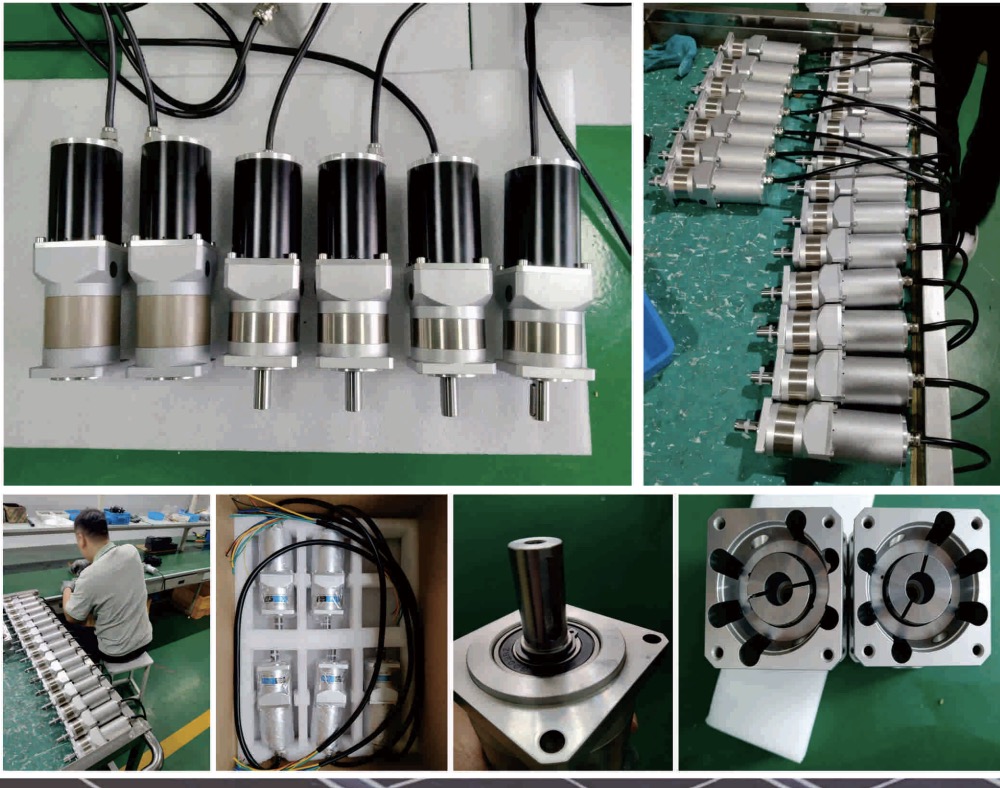
Shenghe Zhilian is ISO 9001 certified with CE/LVD and RoHS compliance; we do not hold ISO 13485. We build 15 W to 3,000 W BLDC motors, L-type and planetary gear motors, controllers and brakes, and every motor leaves with serial-numbered resistance, insulation, hipot and no-load records. We sign customer supplier quality agreements, freeze configurations for medical customers and give advance notice of the changes listed above.
That makes us a fit for hospital beds, patient-handling equipment, powered mobility and hospital logistics vehicles. It does not make us the right supplier for ventilator blowers, infusion mechanisms or anything implantable — for those, choose a supplier with an ISO 13485 certificate covering the relevant design and production scope. For background on motor types and power ranges across medical applications, read our BLDC motors for medical devices guide.
Frequently Asked Questions
Does a brushless motor supplier need ISO 13485 certification?
Not as a legal requirement. ISO 13485 certifies the device manufacturer’s quality system; clause 7.4 requires you to select and control suppliers according to their ability and the risk of the purchased product. A certified supplier reduces effort for high-risk devices, but for many Class I and II devices an ISO 9001 motor maker under a written supplier quality agreement is the normal route.
Does FDA require component suppliers to follow the QMSR or ISO 13485?
No. The QMSR (21 CFR 820, incorporating ISO 13485:2016, effective February 2, 2026) keeps 820.1(a)(2): it does not apply to manufacturers of components or parts of finished devices, who are encouraged to consider its provisions. Responsibility stays with the device maker’s purchasing controls. FDA will not require ISO 13485 certificates, and a certificate does not exempt anyone from inspection.
What should a supplier quality agreement for a BLDC motor include?
A frozen BOM and drawing revision; written advance notice of changes (ISO 13485 7.4.2) with a 90–180 day period; traceability from serial number to magnet, wire, bearing and Hall IC lots; serial-numbered test records kept for at least the device lifetime and not less than two years (4.2.5); nonconformance response times; last-time-buy notice; RoHS/REACH declarations; and audit rights.
Which motor changes should require notification to a medical device maker?
Magnet grade or supplier, magnet wire or insulation class, varnish process, bearing brand or grease, gear material or heat treatment, Hall IC part number, lead wire or connector, controller firmware, a line or factory move, and any newly subcontracted process. A grease change alone can shift bedside noise, cold-start current and bearing life.
Does the motor itself need IEC 60601-1 certification?
No — IEC 60601-1 and 60601-1-2 apply to the complete equipment. A 24 V or 48 V motor on the secondary side of a medical-grade power supply is normally outside the patient-protection path and only needs motor-standard insulation. A mains-connected motor would have to form part of the 2 MOPP barrier: 4,000 V AC and 8 mm creepage at 250 V.
How long does it take to qualify a new motor supplier for a medical device?
For a standard or lightly customised BLDC gear motor, about 10–16 weeks: questionnaire and audit, samples, your design verification, then first-article inspection and a signed supplier quality agreement with the first order. Fully custom motors add roughly 6–10 weeks for tooling and prototypes.
Request a Quote Under Your Supplier Agreement
Send the device type, load, duty cycle, supply voltage and your SQA template. We will propose a BLDC drive, confirm which clauses we can sign, and ship samples with full serial-numbered test data. MOQ 50 pcs, samples in 7–10 days.